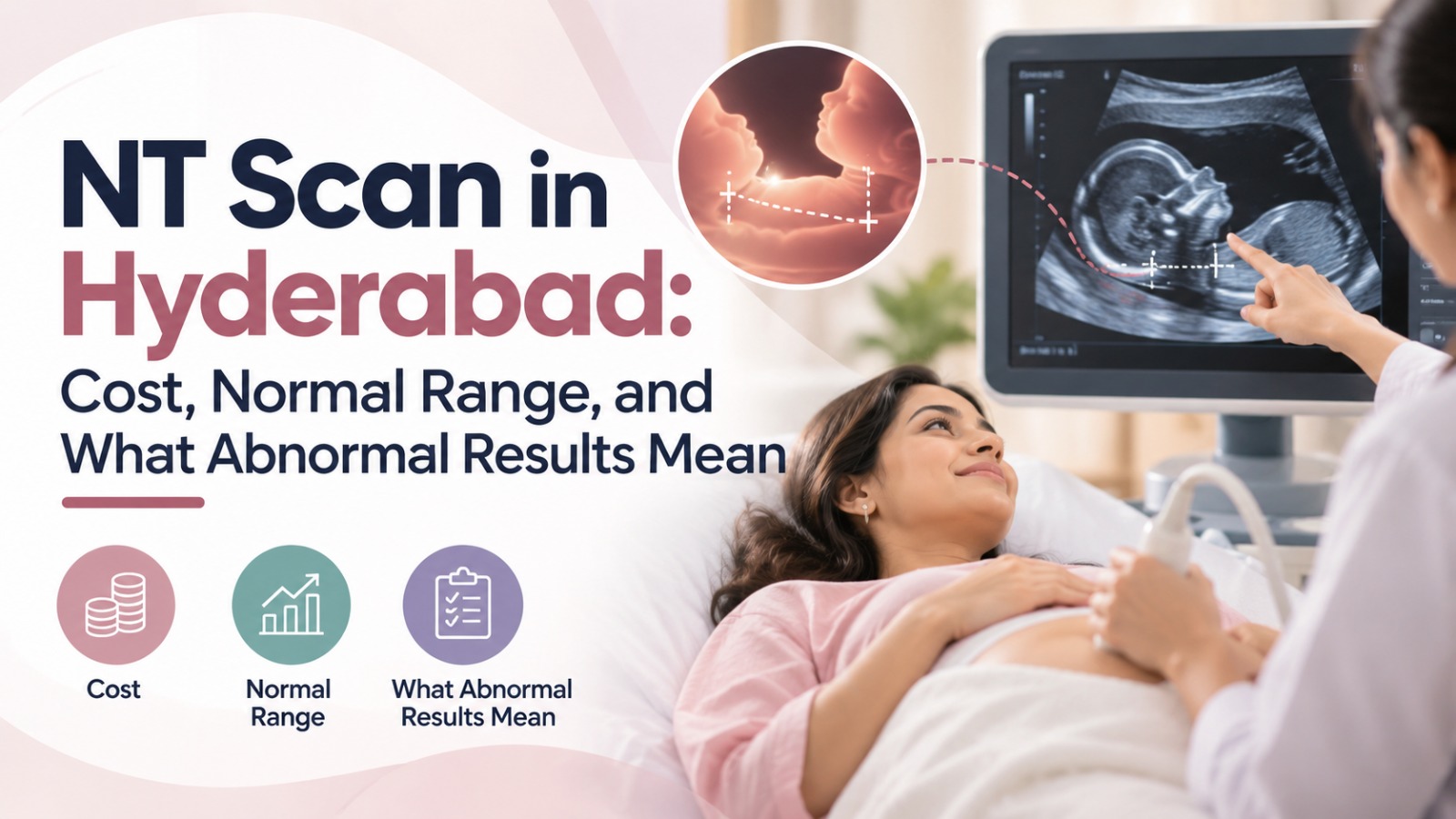
The NT scan is one of those appointments that most pregnant women know they need to have - but very few feel fully prepared for when they walk in. You have been told it is important. You know it happens somewhere in the first trimester. But what exactly is being measured, what does a normal result look like, and - more importantly - what happens if your result does not come back the way you hoped?
These are the questions that matter. And they are the questions this guide will answer, clearly and completely, so that whether you are preparing for your NT scan or trying to make sense of a result you have already received, you leave with a real understanding of what it all means.
What the NT Scan Is and Why It Is Done
NT stands for Nuchal Translucency - a medical term for the fluid-filled space at the back of your baby's neck. Every baby has this space in early pregnancy. What the NT scan measures is how thick that space is.
The reason this measurement matters is rooted in genetics. Babies with certain chromosomal conditions - most commonly Down syndrome, Edwards syndrome, and Patau syndrome - tend to accumulate more fluid in this space than babies without those conditions. A larger-than-average NT measurement therefore signals a higher statistical probability of a chromosomal abnormality - not a confirmed diagnosis, but an elevated risk that warrants further investigation.
The NT scan is a screening test, not a diagnostic test. This distinction is critical and worth understanding before you even walk into the appointment. A screening test tells you about probability. A diagnostic test - like amniocentesis - tells you with near-certainty whether a condition is present. The NT scan belongs firmly in the first category.
Key takeaway: An NT scan result - whether reassuring or elevated - is always the beginning of a conversation with your fetal medicine doctor, not the end of one.
How the NT Scan Is Different From Other Fetal Scans
Your pregnancy care journey involves multiple ultrasound scans across all three trimesters. Each one has a specific purpose, and the NT scan sits in a unique position among them.
A viability or dating scan confirms the pregnancy and estimates your due date. The TIFFA scan at 18 to 22 weeks examines your baby's full anatomy in detail. Growth scans in the third trimester track weight and position. All of these are important - but none of them is designed to assess chromosomal risk the way the NT scan is.
What makes the NT scan particularly valuable is that it sits at a very specific developmental window - between 11 and 14 weeks - when the nuchal translucency measurement is at its most clinically useful. Too early and the measurement is unreliable. Too late and the fluid naturally absorbs into the body, making the measurement meaningless.
It is also typically performed alongside a blood test - the double marker test - to combine both sets of data into a single risk score. This combined first-trimester screening approach is significantly more accurate than either test alone.
When to Have the NT Scan in Hyderabad
The NT scan must be performed between 11 weeks and 13 weeks 6 days of pregnancy. This is a fixed clinical window - not an approximation - and it exists for a precise biological reason.
Before 11 weeks, the fetus is too small for the nuchal translucency measurement to be technically reliable. After 14 weeks, the fluid begins to absorb naturally into the baby's lymphatic system, and the measurement loses its diagnostic significance.
Within this window, most fetal medicine specialists recommend aiming for 12 to 13 weeks where possible. At this point the baby is large enough for a clear, accurate measurement, and there is still time to arrange the associated double marker blood test within the same visit or within a few days.
Practical advice for women in Hyderabad: Book your NT scan appointment as soon as you receive your first antenatal appointment date, do not wait until you are already in the window. If you are unsure of your exact gestational age, your fetal medicine doctor will confirm it at the scan itself using the crown-rump length measurement before proceeding with the NT assessment.
What Happens During the NT Scan Appointment
Knowing what to expect during the appointment significantly reduces the anxiety most women feel going in.
The NT scan is performed using standard ultrasound technology - the same type of scan you have at every other prenatal appointment. It is non-invasive, painless, and safe for both you and your baby. No radiation is involved.
You will lie on an examination table and a gel will be applied to your abdomen. The sonologist will use a transducer to get clear images of the baby. In some cases - particularly in early pregnancy or depending on body type - a transvaginal scan may be recommended instead of or in addition to the abdominal scan, to get a clearer image. This is a normal clinical decision, not a sign of concern.
The sonologist will first measure the baby's crown-rump length to confirm gestational age. Then they will carefully position the image to capture the exact cross-section needed to measure the nuchal translucency space. This measurement needs to be technically precise - the cursor is placed at very specific points on the image - which is why the training and certification of the person performing the scan matters enormously.
The appointment typically takes between 20 and 30 minutes. If the baby is not in the right position, you may be asked to walk around briefly and return for a second attempt.
NT Scan Normal Range - What the Numbers Mean
The nuchal translucency measurement is recorded in millimetres. Understanding what the numbers mean prevents a lot of unnecessary anxiety.
| NT Measurement | What It Indicates |
|---|---|
| Less than 2.5 mm | Low risk - within normal range for most gestational ages |
| 2.5 mm to 3.5 mm | Borderline - requires interpretation alongside blood markers and maternal age |
| 3.5 mm and above | Elevated - further investigation strongly recommended |
These numbers are not interpreted in isolation. The NT measurement is always read alongside:
- Maternal age - chromosomal risk increases with age, so the same NT value carries different weight at 28 versus 38.
- Gestational age - NT naturally increases slightly as the baby grows, so 2.5 mm at 11 weeks means something different from 2.5 mm at 13 weeks.
- Double marker blood test results - PAPP-A and free beta-hCG levels are combined with the NT measurement to calculate an overall risk score.
- Nasal bone presence - the NT scan also checks whether the nasal bone is visible, which is an additional marker for chromosomal risk assessment.
Key takeaway: Do not interpret your NT measurement number alone. The combined risk score - produced by your fetal medicine specialist after factoring in all variables - is what carries clinical weight, not the millimetre figure in isolation.
What an Abnormal NT Scan Result Actually Tells You
This is the section most women need most, and the one that is most frequently misunderstood.
An elevated NT measurement - or a combined risk score that falls above a certain threshold - does not mean your baby has Down syndrome or any other chromosomal condition. It means the statistical probability of such a condition is higher than the general population average. That is an important and very different statement.
To understand this practically: if your combined first-trimester screening returns a risk of 1 in 100 for Down syndrome, that means that out of 100 pregnancies with the same profile, approximately one baby would be affected - and 99 would not be. A risk of 1 in 50 means two out of 50, with 48 unaffected. These are elevated risks relative to population averages, but they are still probabilities, not certainties.
What an abnormal result does is guide the next step in your care. Your fetal medicine doctor will typically recommend one or more of the following:
- NIPT (Non-Invasive Prenatal Testing) - a highly sensitive blood test that analyses fragments of fetal DNA in your bloodstream to assess chromosomal risk with far greater accuracy than the NT scan alone. This is still a screening test, but a significantly more precise one.
- Detailed anomaly scan - your fetal medicine specialist may recommend an early detailed scan to look at structural markers alongside the NT finding.
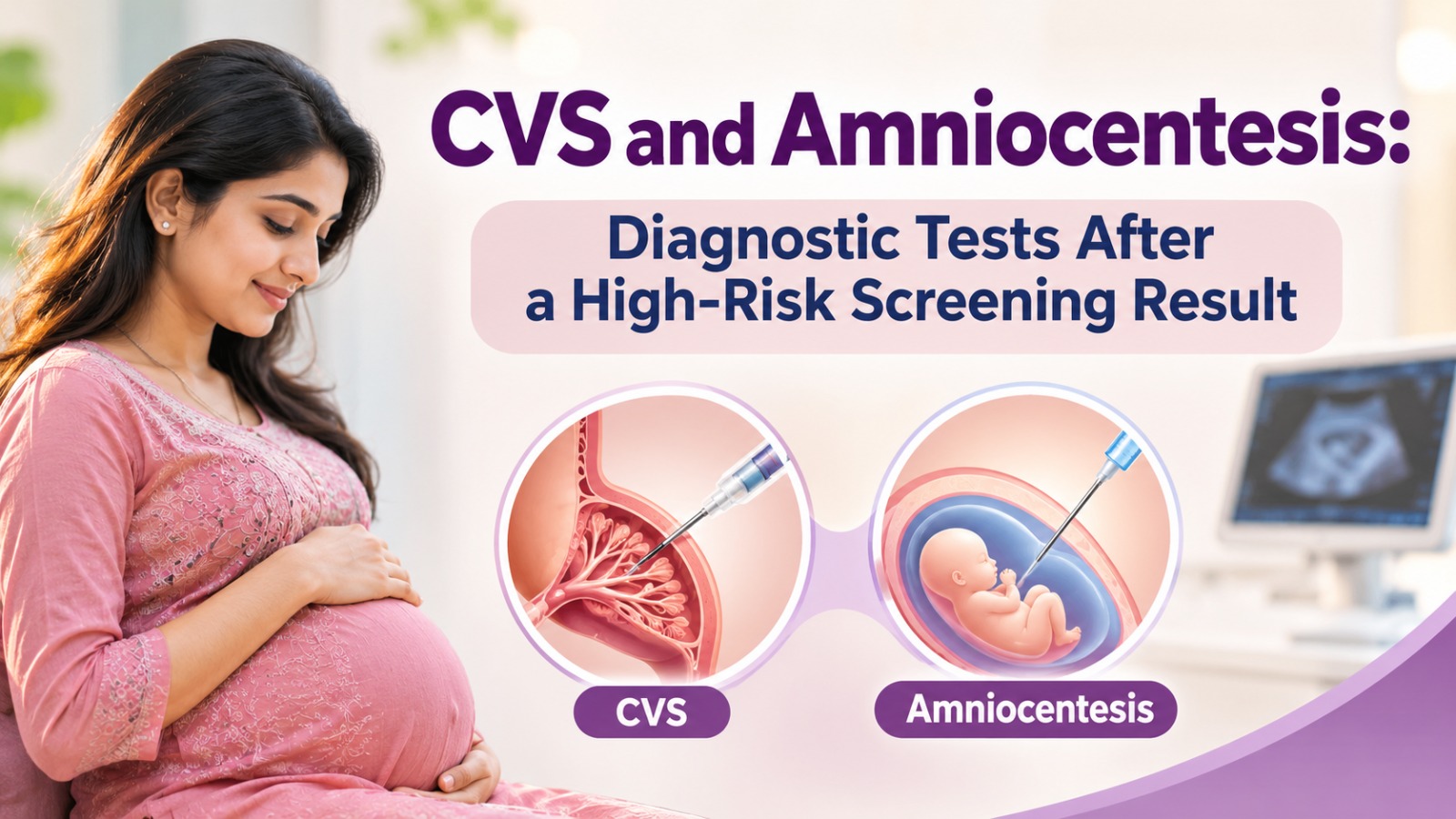
- Amniocentesis or CVS - if you wish to move from screening to diagnosis, these invasive procedures can give a near-definitive answer about chromosomal status. Both carry a small procedural risk and are typically only recommended when the combined data strongly supports further investigation.
- Genetic counseling - a genetic counselor at a qualified fetal medicine centre will walk you through your specific risk figures, explain your options without pressure, and give you the space to make an informed decision.
The most important thing to understand is this: an abnormal NT scan result is a signal to gather more information, not a verdict on your pregnancy.
NT Scan Combined With the Double Marker Test
The NT scan and the double marker test are designed to work together - and combining them produces a result that is substantially more accurate than either test alone.
The double marker test is a blood test that measures two specific proteins in your blood:
- PAPP-A (Pregnancy-Associated Plasma Protein A) - produced by the placenta; low levels in the first trimester are associated with higher chromosomal risk.
- Free beta-hCG (human Chorionic Gonadotropin) - a pregnancy hormone; elevated levels in the first trimester are associated with higher chromosomal risk for certain conditions.
When these two blood values are combined with the NT measurement and your maternal age, a software algorithm calculates a final combined risk score. This combined approach - called first-trimester combined screening - has a detection rate of approximately 90 to 95 percent for Down syndrome when performed correctly by a qualified fetal medicine specialist.
Actionable advice: Try to have the double marker blood test done either on the same day as your NT scan or within a few days of it. The closer together the two tests are performed, the more accurate the combined calculation will be.
NT Scan vs NIPT - Which One Do You Need
This is one of the most common questions women ask when planning their first-trimester pregnancy care, and the answer depends on several factors.
The NT scan combined with the double marker test is the standard first-trimester screening recommendation for all pregnant women. It is widely available across Hyderabad, is less expensive than NIPT, and provides a reliable risk assessment when performed well.
NIPT - Non-Invasive Prenatal Testing - is a more advanced and more accurate screening option that analyses cell-free fetal DNA from a blood sample. It has a higher sensitivity and specificity for chromosomal conditions, but it is more expensive and is still a screening test, not a diagnostic one.
Your fetal medicine doctor may recommend NIPT in addition to - or instead of - the combined first-trimester screening if:
- You are 35 or older at the time of delivery
- You have a family history of chromosomal conditions
- A previous pregnancy was affected by a chromosomal condition
- Your NT or double marker result comes back as elevated risk
- You simply want the most accurate non-invasive screening available
Neither test is mandatory. Both are tools to help you make informed decisions. The right choice depends on your individual risk profile, your preferences, and a clear conversation with your fetal medicine specialist about what each test can and cannot tell you.
Choosing the Right Fetal Medicine Centre for Your NT Scan in Hyderabad
The accuracy of the NT scan depends more on the skill of the person performing it than on almost any other factor. The measurement window is precise, the positioning requirements are exacting, and a measurement that is even slightly off can significantly alter the risk calculation that follows.
When choosing where to have your NT scan in Hyderabad, ask directly whether the sonologist performing your scan is certified by the Fetal Medicine Foundation. FMF certification for NT scanning is the internationally recognized standard of competency - it means the sonologist has been trained in the specific technique, has had their measurements independently audited, and meets a verified standard of accuracy.
A dedicated fetal medicine centre will also have a fetal medicine specialist available to discuss your results in context - not just hand you a report with a number on it. If your result is borderline or elevated, the conversation that follows the scan is just as important as the scan itself. That conversation should happen with someone who is genuinely qualified to have it.
Look also for a centre where the NT scan and double marker blood test can be coordinated in a single visit or within a streamlined workflow. Having to manage multiple separate appointments across different facilities adds unnecessary logistical stress to what is already an emotionally significant day.
NT Scan Cost in Hyderabad
NT scan pricing in Hyderabad varies based on the type of facility and whether the double marker blood test is included in the package or priced separately.
General pricing reference:
| Facility Type | NT Scan Only | NT Scan + Double Marker Combined |
|---|---|---|
| Standalone diagnostic centre | Lower range | Mid range |
| Private hospital with obstetrics | Mid range | Mid to upper range |
| Dedicated fetal medicine centre | Upper range | Upper range |
What to clarify before booking:
- Is the double marker blood test included in the quoted price or billed separately?
- Is genetic counseling or result discussion included, or does that require a separate consultation fee?
- Is the sonologist FMF-certified - this is a quality question as much as a cost question?
- Are NIPT options available at the same centre if your result comes back elevated?
Actionable advice: The NT scan is not the appointment to choose based on lowest price. The accuracy of the measurement directly determines the reliability of your combined risk score - and that score may influence significant decisions about your pregnancy care. Prioritize quality of expertise over cost savings at this particular scan.
Frequently Asked Questions
What is the NT scan in pregnancy?
It is a first-trimester ultrasound that measures the fluid-filled space at the back of the baby's neck to assess the risk of chromosomal conditions like Down syndrome.
When should I have the NT scan in Hyderabad?
Between 11 weeks and 13 weeks 6 days of pregnancy - ideally around 12 to 13 weeks for the most reliable measurement.
What is a normal NT scan measurement?
Generally below 2.5 mm is considered within the normal range, though this is always interpreted alongside blood test results and maternal age by your fetal medicine specialist.
Does a high NT measurement mean my baby has Down syndrome?
No - it means the statistical probability of a chromosomal condition is elevated. Further testing like NIPT or amniocentesis is required for a more definitive assessment.
Is the NT scan painful?
No - it is a standard ultrasound scan that is completely painless and safe for both mother and baby.
Final Thoughts
The NT scan sits at the very beginning of your pregnancy screening journey - and getting it right, at the right time, at the right fetal medicine centre, sets the foundation for every informed decision that follows. For the vast majority of women, the NT scan is a reassuring experience that confirms all is well and clears the path forward. For those where a result requires further attention, understanding what that result actually means - a probability, not a verdict - makes all the difference in how you navigate the next steps. Whatever your result, approach it as the start of a conversation with your fetal medicine specialist, not as a conclusion.
Disclaimer: The information on this page is intended for general educational purposes and does not replace professional medical advice. The content is not designed to diagnose, treat, cure, or prevent any medical condition. Consult a qualified fetal medicine specialist or gynecologist with any questions regarding your NT scan results or pregnancy care. Do not delay seeking professional advice based on anything you have read here.

.jpeg)